 Roderik
 Provinces in the Netherlands have ambitious sustainability goals. For instance, CO₂ emissions must be drastically reduced by 2030, and there is an increasing focus on circular procurement and energy-efficient buildings. The goals are clear, but the question remains: how do you make those ambitions concrete in the daily management of buildings?
For the Province of North Holland, digitalization plays an important role in this. Analyzing data from buildings provides insight into how installations function, where energy is consumed, and where improvements are possible.
According to contract manager Jildert Douma, sustainability begins with insight. Modern buildings feature an increasing number of installations and sensors that provide data via the building management system. This data reveals how installations perform and where energy can be saved.
“If you want to optimize buildings, you must first thoroughly understand how they function,” is his conviction. "This applies not only to new properties, but also to existing and even monumental buildings."
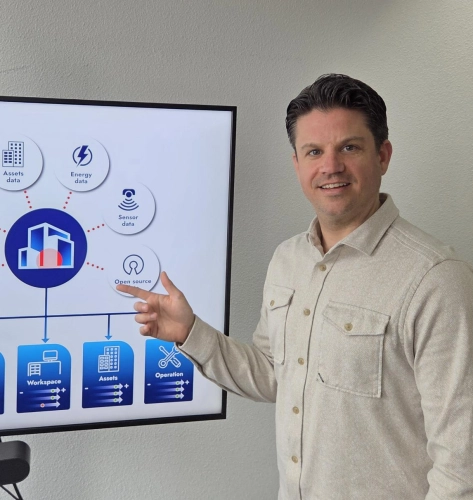
To gain this insight, the province is collaborating with SPIE. Within this collaboration, PULSE CORE plays a central role. The platform brings together data from installations, energy consumption, and failure processes in one place. This makes visible how buildings perform and where opportunities for improvement lie.
Technical performance of installations is monitored using KPIs. This creates real-time insight into the functioning of buildings. This information helps make targeted choices regarding maintenance, optimization, and sustainability.
The insights from the PULSE CORE platform are not limited to dashboards. In practice, it leads to concrete improvement actions: at the Huis van Hilde in Castricum, for example, it turned out that heating boilers were actually no longer needed alongside a heat pump installation. In another building, it was discovered that heat generation remained unnecessarily active at night and on weekends. By adjusting the control strategy, energy loss was prevented.
According to the parties involved, the strength lies not only in technology, but above all in the combination of data, expertise, and collaboration. By combining technical knowledge of installations with data analysis, a clearer picture emerges of how buildings function. In addition, data makes it possible to apply new technologies, such as AI models. This allows, for example, energy consumption to be predicted and installations to be automatically optimized based on factors such as indoor climate, user behavior, and weather forecasts.
In this way, digitalization is increasingly becoming a key to sustainability. By continuously monitoring buildings and providing insight into performance, organizations can steer more effectively towards energy use, comfort, and the future-proofing of their real estate.
Source: Duurzaam Gebouwd